You own a business, or maybe you are making a name for yourself in your profession. Content is king, the business growth gurus say on social. Use AI to churn it out, they say. It is fast, and it is cheap, and you will game the system, they say.
Lately, every time I am on social media, I see another ad for a shiny new AI tool that claims it will do all my marketing and content creation for me. I answer a few prompts, and a few minutes later, I have a website.
AI bots, it seems, can do just about everything these days. For the cost of a few coffees a month, Claude, ChatGPT, or Gemini can vibe code my website, create all my images and videos, and then write all of my blog articles, too.
It is true. They can. But there is a catch.
Or, to quote Dr. Ian Malcolm:
Your scientists were so preoccupied with whether or not they could that they didn't stop to think if they should.
During her talk at the Lenny & Friends Summit, Katie Dill, head of design at Stripe, likened these websites to the "zombie buildings" that proliferated across American architecture after World War II.
The combination of simpler and cheaper building methods plus post-war demand turned into an architectural style that sucked the soul and functionality out of a few decades' worth of buildings.
Katie says we are in a new building boom, only this time it is AI website building. I could not agree more. Zombie AI builds have no soul, are light on functionality, and are built with little or, depending on the bot you choose, zero intentionality.
Or, as Syndrome put it:

What Are Vibe Coding and AI Slop, and How Did We Get Here?
A zombie really only has one goal: it wants to eat some yummy brains. When it comes to zombie builds, or what we can think of as lazy vibe coding, we may not be eating brains, but we certainly are not always using them.
What is vibe coding?
Vibe coding is a software development method where a person describes what they want to build in plain language, and an AI tool generates, tests, or refines the code. The idea traces back to January 2023, when Andrej Karpathy, a founding member of OpenAI, posted that "the hottest new programming language is English."
The term did not exist yet, but Karpathy's post captured the nature of what vibe coding would become: I talk, it builds. Karpathy coined the phrase itself in February 2025, and the practice has grown fast ever since.
Vibe coding has helped software engineers work faster, but more importantly, it has let everyday people with no coding background build things they never could have before. Now, everyone is limited only by their imagination.
It has brought new problems, too. Building a website now takes hours instead of months, which often means websites get built with minimal thought about design and content. And because the code and the writing are all coming from the same handful of AI models, these websites, blog posts and quick-turn pieces are starting to look and sound alike. Just as Katie Dill said: zombie builds.
The content you put into the world through your website, your blog, or your social posts is a digital welcome mat. Many times it is the first impression a prospect will have of you and your brand. The stakes are not small. The painstaking time we used to spend crafting strong messaging and thoughtful journeys has, too often, been reduced to letting AI vibe it out.
What is AI slop?
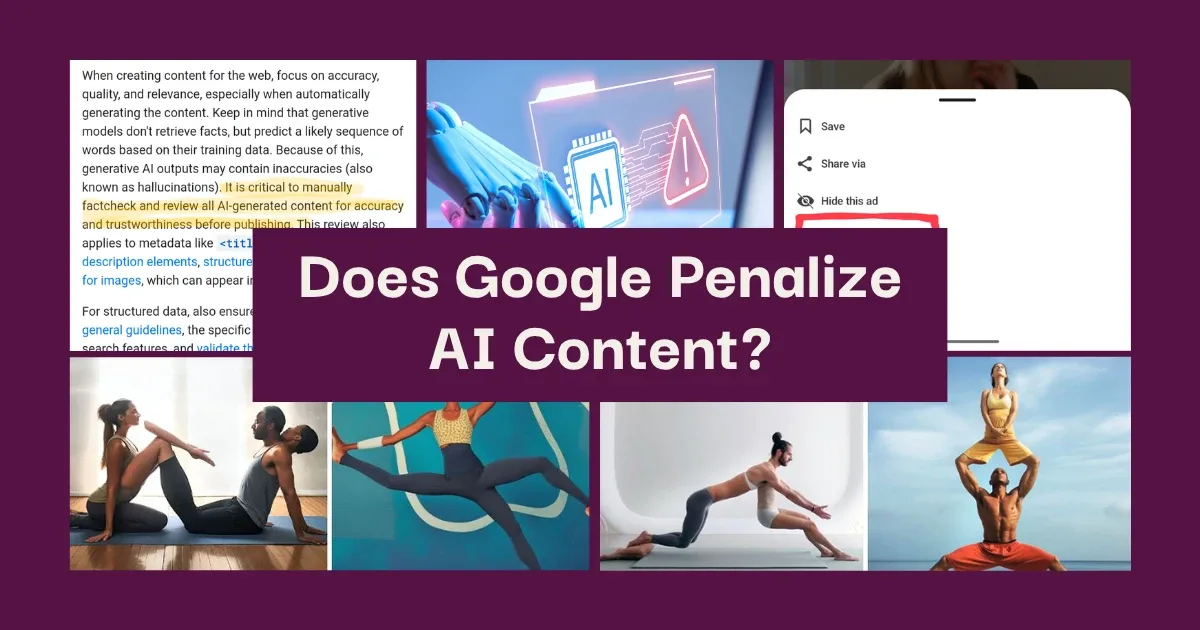
"AI slop" started as a term for bad AI images. When tools like DALL-E and Midjourney took off in 2022 and 2023, developers and artists needed shorthand for the flood of low-quality media. AI slop is how we got all those anatomically inventive yoga poses.

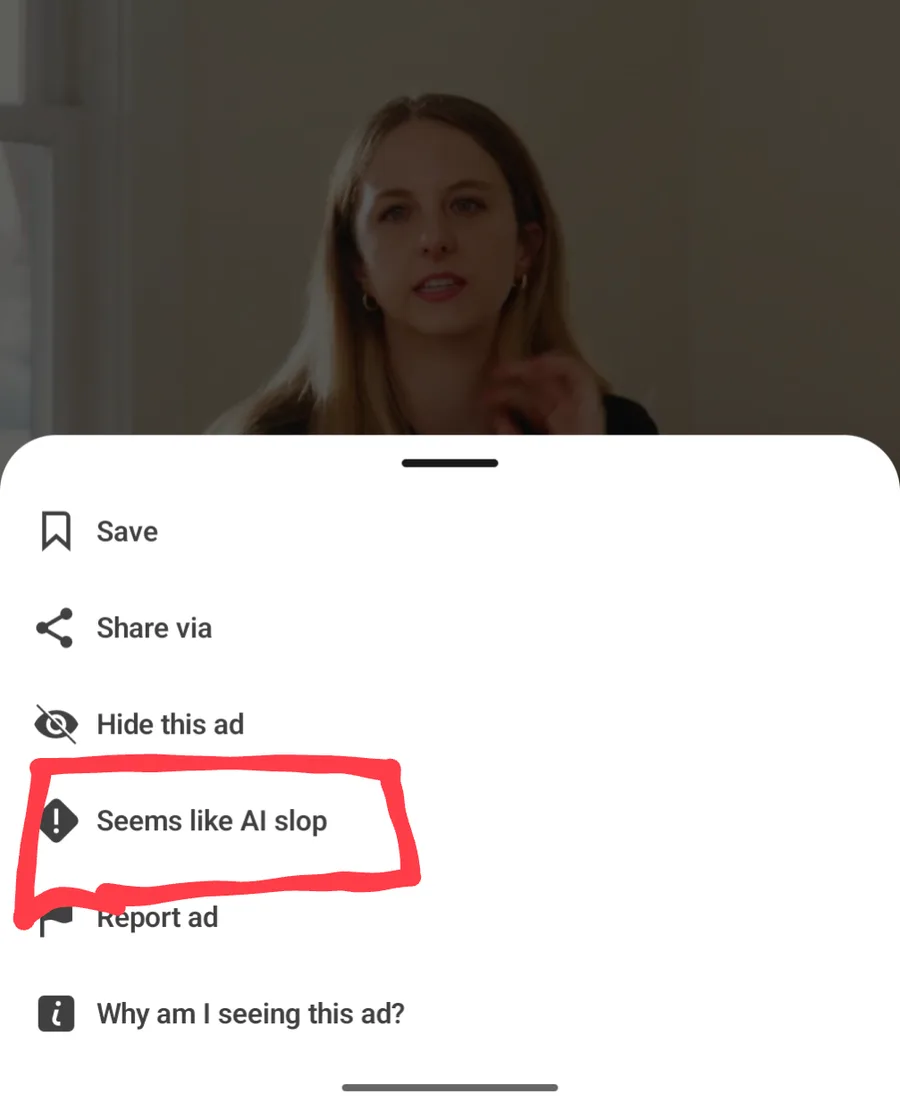
Today, AI slop, or just "slop," covers low-quality images, lazy vibe coding, and poorly generated writing such as social posts. LinkedIn even added a "Seems like AI slop" report option in July 2026.
The more business owners, marketers and bloggers lean on AI as a shortcut instead of as a tool that supports their unique perspective and proven process, the more slop shows up in our feeds, on our road signs, and on our websites.
How did we get so (AI) sloppy?
It is simple. We all want everything faster. Faster food, faster internet, faster outputs, faster results. You name it, and we probably want it faster. Sociologist Hartmut Rosa built a framework called Social Acceleration Theory to examine exactly this.
Social Acceleration Theory rests on three core ideas:
- Technological acceleration. People have gotten used to faster transit, instant messaging, and of course, AI.
- Acceleration of social change. Faster job turnover, quickly shifting social norms, and more.
- Acceleration of the pace of life. We eat faster, sleep less, and carry a higher sense of dread from time pressure.
It is easy to lose our way when we forget where we are going, and that is exactly what has happened with digital marketing, especially websites. Our websites are more than checklist items. They are the central hub of our marketing.
Why Does Your Website Exist in the First Place?
Let us take a step back and think about why we, businesses large and small, have websites.
The point of a great website and blog is not simply to have them. Your website is not a luxury handbag. Your blog is not a European car. Heck, they are not even a pair of Crocs with all the coolest Pokémon charms.
A website is a tool, not a status symbol.
Your website might have fun bells and whistles, but it ultimately exists to bring potential customers to your business and show them what makes you unique and why you are the best fit for them.
Taking it one step further, your website should be a tool for good. When we create websites, we need to keep the people who will visit in mind and add genuine value to their lives through the layout, the colors, the words, and the actions we ask them to take.
Want specifics?
Five ways your website works as a tool
- It helps Google understand what your business is. Your pages, navigation, links, locations, services, and structure are not just about user experience (although that is important). They teach search engines what you do, who you serve, and when you are relevant.
- It creates multiple pathways for people to find you. Well-executed search engine optimization helps different pages rank for different searches, so people can find you whether they are looking for services, locations, industries, products, or problems.
- It turns traffic into qualified leads. A good website does not just attract visitors. It educates, answers questions, and lets prospects decide whether you are the right fit. It should propel visitors to action.
- It finds customers close to home. Google has gotten very good at geofencing, which works like a digital border around you. Geofences are why, whether you are searching for a tire shop, a campsite, or an SEO agency, your results skew toward your physical location.
- It gives you data to improve your marketing. Think of your website as a treasure chest. Inside are search queries, traffic patterns, conversions, page behavior, and downloads, all telling you what your customers want, how they find you, and whether your messaging works. And if pirate movies have taught us anything, it is that buried treasure is meant to be found. (Unless it is cursed, obviously.)
Five ways your blog works as a tool
- It captures searches your main pages cannot. Blog posts can answer highly specific questions and compare your products and services to others, meeting searches that lead customers to you.
- It builds authority around the things you want to rank for. Depth around your primary services or products establishes you as an authority with customers and with search engines.
- It earns backlinks more naturally than your main pages. A backlink is another site linking to your page. The more quality backlinks you have, the more signals Google has that your content is credible and useful. People are far more likely to link to a useful guide, original research, or a genuinely helpful article than to a sales page.
- It captures long-tail queries. AI has changed how people search. A few years ago, someone might have Googled weeknight chicken recipe with bacon. Now they are more likely to type: I need a 30-minute dinner. I have a pound of chicken thighs, half a package of bacon, and leftover cream. My kids hate onions but do not mind mushrooms. Specific, thorough pages are what AI search engines pull from when they answer questions like that.
- It becomes the source material for everything else. Struggling to fill your newsletter or social calendar? Start with a strong blog article and you have everything you need for both.
There are far more ways websites and blogs serve you and your business, but I hope this shows that your website does more than you may have realized. With that in hand, you are probably already asking the next question.
If I use AI to build and write my website, will anyone find me? Increasingly, the answer is no.
To understand why, we need to talk about some of the biggest news affecting you right now, even if you have never heard of it: Google's 2026 spam updates and its new guidance on AI content.
What Did Google Change in Its 2026 Spam Updates and AI Content Guidance?
At the time of publication, Google's September 2026 spam update has just finished rolling out, and on October 1 Google revised its official guidance page on generative AI content. Like most things Google does, it told us an update was happening and gave us the basics, but not much more. Over the coming weeks and months, SEO pros will learn more about the changes and their real-world impact.
What makes this update different
Spam updates are not unusual. Since Google started naming them in 2021, there have typically been one to three a year. This one is different in two big ways.
An unusually long rollout. Most spam updates finish in a day or two. Maybe three. The September 2026 update ran for two weeks. That is a lot of change.
Google has published four spam updates so far in 2026. That has only happened once before, in 2021, which was also the first year Google started naming spam updates as it published them. Before that, spam fighting was folded into other systems. In other words, the only other year with four spam updates was the year spam updates were born.
Here are the four updates this year, in order:
- March 2026. No new policies announced. It finished in about 19.5 hours, the shortest spam update in Google's dashboard history.
- June 2026. No new policies announced.
- August 2026. This one caused more ranking volatility than most. Search Engine Land published SE Ranking data showing that 16.71% of URLs that had ranked in Google's top 10 fell beyond position 100 for the same keyword, compared with 9.2% during a similar five-day period in July.
- September 2026. This update took 13 days and 16 hours to complete. Google would not name a specific policy target or explain why it took so much longer to roll out. 🙄 (A human added this eye-rolling emoji. You are welcome.)
Separately from those updates, Google has also been working on a new system named SAFE (Scaled Abuse Forensics Examiner). This spam detector is smarter, more advanced, and built to find AI-generated spam. So far it has mainly been described in the context of AI video content pumped out at scale across networks, but SAFE is one more sign of Google's focus on cracking down on poor AI content.
What Google is actually targeting
Google's crackdown targets three identifying characteristics of generative AI output:
- Content that looks low-effort or lazy
- Content that lacks originality
- Content that is inaccurate or does not add value
Or, as Katie Dill would put it, zombie builds.
Google is not telling anyone to avoid AI when creating content. Considering how heavily it advertises Gemini, it is quite the opposite. Google wants us to use AI. It just does not want us to abuse AI.
The October revision to Google's generative AI guidance also gave us something tangible: a reminder that these models predict likely words rather than retrieve facts, so everything they produce needs a human fact-check before it goes live. That includes the technical pieces most people never look at, such as titles, meta descriptions, structured data (the code that tells search engines what a page is about) and image alt text.
How Do These Changes Affect Your Website?
I am encouraged by Google's updates and how they are clearing out AI slop. I picture a great bulldozer pushing away rubbish so the authentic things can shine.
This raises two important questions I am now addressing with all of my clients:
How do I make sure my website and blog will not be labeled as AI spam?
Is there any way to still get the productivity advantages AI brings?
The answers to both are nuanced, which is exactly why having an SEO and digital marketing partner matters more than ever. HMM works with clients from pet supplies to manufacturing to energy, so I do not want to paint with too broad a brush. The best practices below apply to most businesses. They should keep you off the spam list while still letting you use AI tools.
Human editors are essential
You can use AI to research, pull quotes from transcripts, and even build an outline or a rough draft. That is where AI should end and a human editor should begin.
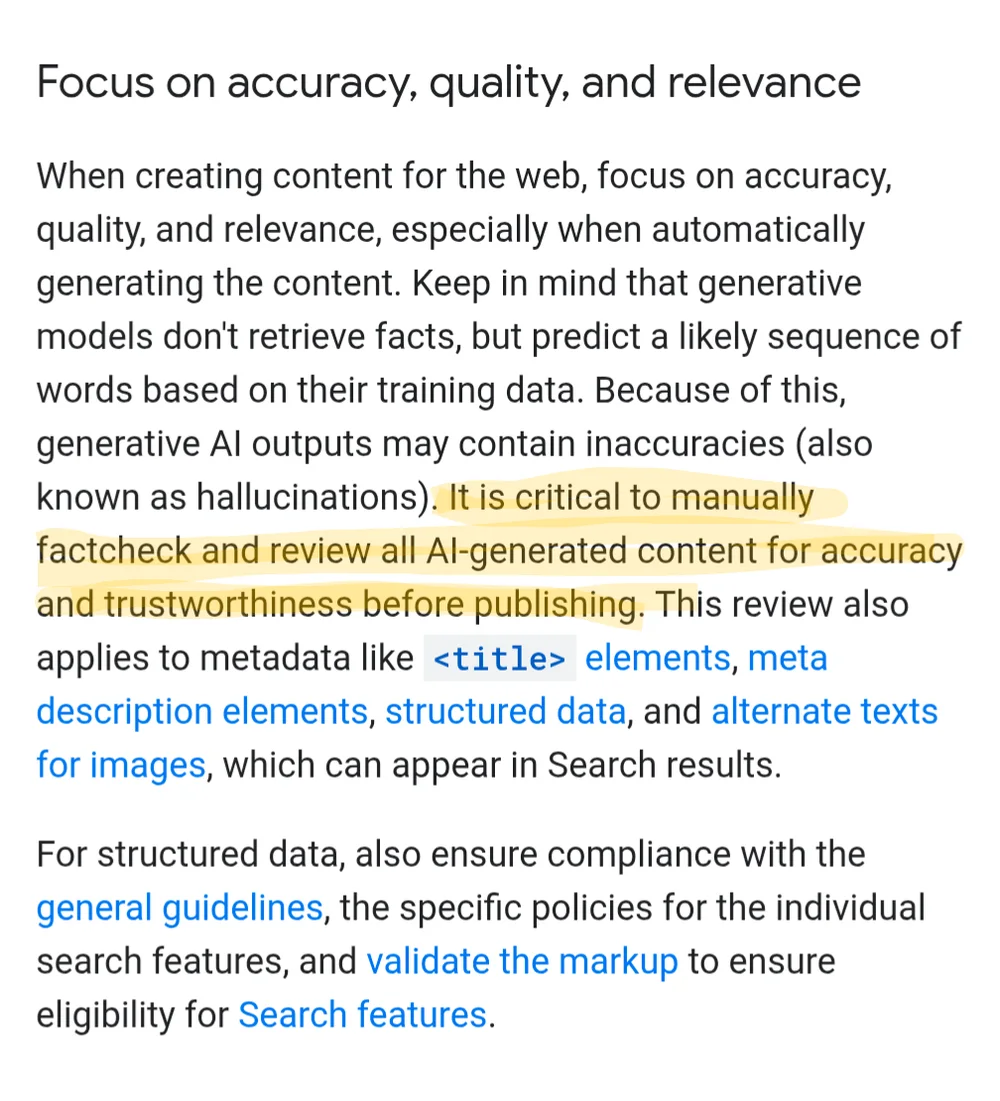
Human editors are needed on the front end and the back end. Vibe coders are notoriously bad at reviewing the technical SEO elements their tools generate, like site schema, meta titles, and image alt text. Google's revised guidance is an official nudge to proofread all of it.
Search engines lean on that back-end content to understand what a page is about, and Google says the review applies there too. Getting human eyes on the back end of your website is essential.
Experts, beware
Credentials do not rescue content. Putting your bio at the end of an article you had AI write will not get past the new spam filters, even if that bio includes a few PhDs.
Say you are an expert and you do not like writing. Your marketing team is on you for blog posts, so you hand the whole job to a generative AI service. Even though you are an expert, and even though you presumably fed the bot accurate information, the finished article can still look exactly like the low-effort, unoriginal content Google is trying to weed out.
A biochemist could use an AI bot to write about biochemistry and still get flagged as AI spam, drop out of the index, and become unfindable online. If the biochemist does not go back and personalize the article with their own analysis, voice, and meaningful conclusions, it still smells like slop.
You can still use AI. You need to use it differently.
- Instead of having a bot write your article, social post, or web page, have it produce the first draft. You take it from there. You can also use it to proofread your work at the tail end.
- Use AI as a brainstorming partner. An outline is a fine place to let it help you get started.
- Use a service like Otter.ai or Fireflies to record your meetings or article interviews, then let AI organize the transcript. Double-check everything, because AI still hallucinates facts and quotes. (More of our favorite tools are here.)
Five tells of a vibe-coded website
Want to know what a human editor catches that the bot does not? Pull up a site you suspect was vibe coded and look for these. I see them every week.
- Eyebrow text on everything. An eyebrow is the tiny all-caps label that sits above a headline. Vibe-coded sites put one on every section, usually with a little line, a glowing dot, an icon, or a pill shape wrapped around it. One is a design choice. Twelve is a template.
- Wall-to-wall text, almost no images. The bot can write paragraphs all day, but it cannot take a photo of your shop, your team, or your work. So the page fills up with words and the only visuals are icons. Real businesses have real pictures.
- A strange font mix. The current favorite is Playfair Display, a formal serif with cursive-style flourishes, paired with Mulish, a plain sans-serif, often with a monospace font (the typewriter-looking one from code editors) sprinkled into labels and numbers. Nobody picked those three on purpose for a dental practice.
- Just a little too symmetrical. Three cards, then three cards, then three cards. Every section centered, every block the same height. Human designers break the grid on purpose to steer your eye. The bot never does.
- Writing with no personality or perspective. The copy could belong to any company in any industry. No opinions, no specifics, no story about how you got here. If you could swap in a competitor's name and nothing would feel wrong, that is the tell.
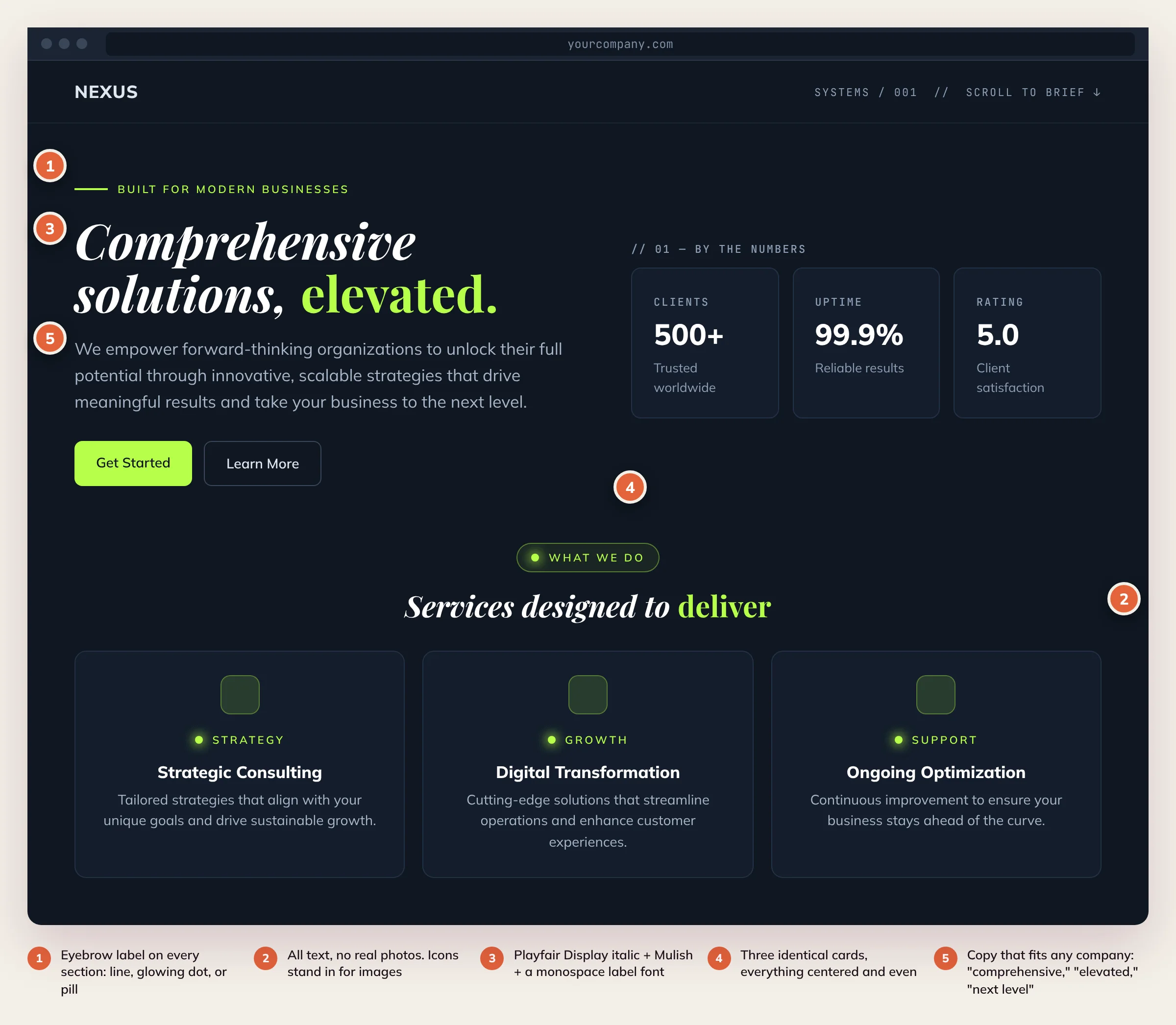
There is a longer list, but this is enough to get you looking. The fix for every one of them is the same: a person who knows the business goes back in and makes it theirs.
AI disclosures may help
Google frames AI disclosure as a trust signal for readers rather than a ranking factor. That is the right way to think about it. Saying when and where you used AI tells readers you have nothing to hide, and it sets up the next point, because your readers are already judging.
If you used AI as your copy editor, I suggest adding something like this at the end of an article:
Written by: [Name]
AI was used to assist in the editing process of this article to look for grammatical errors and typos.
Your customers can sniff out AI
Your customers are human AI-detecting algorithms. Users are increasingly aware of AI-generated content and biased against it. If they sense that one part of your website, blog post, system, or publication was made by AI, they now often assume all of it was.
Have an AI-generated commercial? Is the product even legit?
AI-generated website? Exactly how many minutes old is this company?
AI-slop blog post? Nothing on here is trustworthy.
From books criticized for having AI covers to wedding venues getting negative reviews over AI-generated photos, businesses and creators using AI for shortcuts are facing a growing credibility problem.
Where Does This Leave You?
AI is not bad, but if you use it as a shortcut instead of a tool, you will get nowhere. In this new world of AI-generated content and zombie builds, what wins is authenticity, accuracy, originality and value.
Notice that I did not add perfect to that list. Human-made things are not perfect.
AI is a tool. Leveraged well, it increases our productivity, lets us take on tasks that were once outside our skills, and catches our errors. Used lazily, all we are doing is adding useless slop to a digital world already full of it.
And considering Google's new spam filters, it will not last long anyway.
To learn more about how HMM can help with custom digital marketing that grows your business and gets you discovered by the right prospects, book a meeting.